
Average time for an AI project to go from prototype to production.
Gartner survey of 644 organisations, 2024, reported by CIO DiveReady-made AI training for every department
Your AI, working like a trained specialist in a day, not in months.
Onuris sells ready-made prompt packs that train the AI you already pay for, whether Copilot, Gemini, ChatGPT or Claude, to do each department's work properly. No consultants, no prompt-engineering hire and no months of trial and error. Buy once, from £850, and deploy the same day.
From £850 per departmentOne-off purchaseDeploy the same dayCopilot · Gemini · ChatGPT · Claude
- 01
Choose your department
Fourteen packs, one for each major function of a firm, each written around what that function is for.
- 02
Choose your AI
There is a separate trainer for every AI a firm runs. Each is written for that AI alone, because each one reads instructions differently.
- 03
Deploy the same day
Paste the prompts in and replace the marked variables with your own material. Your AI is now a working agent for that department.
Fig. 01 — The ledger
Months of trial and error, or one day.
Getting an AI to do a department's work properly usually means your own staff writing, testing and rewriting prompts for weeks. Put in your own numbers and see what that costs beside a ready-made trainer.
Your figures, your arithmetic. The starting values are an illustration, not a statistic.
Doing it in-house0
With Onuris0
You keep0
Hours returned0
12 weeks→1 day
Share of AI projects that make it into production at all.
Same Gartner surveyOf generative-AI projects Gartner predicted would be abandoned after proof of concept by the end of 2025.
Gartner, July 2024These figures describe AI projects in general, not prompt writing alone.
Fig. 02 — The drill
A recruit is drilled before the field. So should your AI be.
Onuris was patron of Egypt's army, where raw recruits became soldiers through drill. Nobody expects a talented new hire to perform on day one without being told the role, the rules and the standard. An AI is no different: capable, and untrained in your work. An Onuris agent trainer gives it everything a good induction gives a person.
What training givesA new employeeYour AI, trained by Onuris
01The roleGiven a job descriptionGiven a role and a purpose for every task
02The knowledgeShown the firm's documents and systemsTold exactly which inputs to work from
03The rulesTaught policy and what never to doRules written into every prompt
04The methodShadows a senior colleagueA step-by-step method and an example of your standard
05The reviewWork is checked by a managerSuccess criteria, a review list and escalation rules
06Time to usefulWeeks or monthsThe same day
Fig. 03 — Any AI
Whatever AI your firm runs, there is a trainer for it.
Every agent trainer is written separately for each AI. The Copilot pack and the Claude pack for the same department are different documents: different structure, different order, different instructions.
Claude
Anthropic
- XML-tagged sections, one per component
- Working notes kept in a scratchpad, deliverable returned separately
- Purpose and audience set before the task
ChatGPT
OpenAI
- Markdown headings held as fixed structure
- Told to ask before assuming anything not supplied
- Laid out so long briefs stay easy to navigate
Gemini
- Persona, task, context and format labelling
- Capitalised section labels
- Every figure traced back to its input
Copilot
Microsoft
- Goal first, then context, source and expectations
- Works from the files and threads you name
- Each claim linked to the file it came from
Open models
Llama, Mistral and others
- Compact section markers for smaller context windows
- Tight output guards
- Notes first, then the deliverable, with no preamble
Fig. 04 — The sector dial
One circle. Fourteen sectors. A constellation each.
The zodiac cuts the sky into twelve signs, as the temple ceiling at Dendera shows. The sun also crosses a thirteenth constellation, Ophiuchus, and the Moon and planets pass through a fourteenth, Cetus. We cut the firm the same way: fourteen sectors, each with its own constellation. Turn the dial to see what each pack covers.
Click a sector, or use ← → on the keyboard
What the pack covers
Fig. 05 — Four tiers of depth
From a point to a solid.
Onuris wears a crown of four plumes. Each pack has four tiers, organised by how much they give the AI to work with. Every tier adds a dimension: more context, more method, more control. Start where your team is and move up when the work demands it.
Fig. 06 — The instrument
Set the department, the AI and the depth. Read the result.
This is a real specimen from each pack: one of sixty. Change any setting and the prompt is re-cut for that department, that model and that tier.
Words0
≈ Tokens0
Components0
Variables0
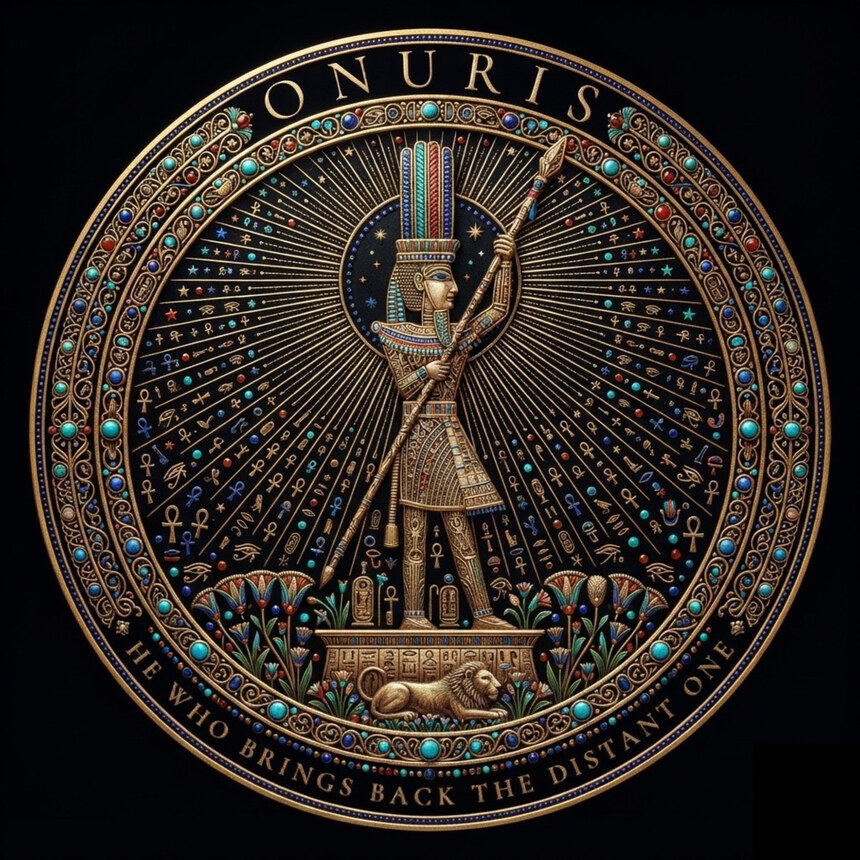
Onuris, Egypt's god of war, bears a name that means “he who brings back the distant one.” What your firm wants from AI is real, and still at a distance. We bring it back, drilled and ready for work.
Fig. 07 — Pricing
Buy one sector, or the whole sky.
One-off purchase. Every pack includes all four tiers. Bundle rates are applied to your order automatically.
Sector
£850per pack
£850 per department
- One department of your choice
- All four tiers, 60 prompts
- Written for the AI you choose
- Fill-in variables throughout
Constellation
£2,600four packs
£650 per department
- Any four departments
- All four tiers, 240 prompts
- Choose the AI for each pack
- Applied automatically at four packs
Firmament
£5,950everything
£425 per department
- All fourteen departments
- All four tiers, 840 prompts
- A trainer for all five AIs
- One licence for the whole firm
Fig. 08 — Questions
Before you commit.
What exactly is in a pack?
Sixty prompts for one department of your firm. Each pack covers six areas of that department's work, and each area comes at four depths: four Point prompts, three Line, two Plane and one Solid. Every prompt is formatted for the AI you choose and marked with variables showing where your firm's own information goes.
Do you retrain or fine-tune the AI model?
No. Nothing is changed inside the model and none of your data is used to train anything. We train it the way you train a person: by giving it the role, the knowledge, the rules and the standard for the job, written down as prompts it follows every time. That is why it works the same day.
Why does it matter which AI we use?
Models respond best to different structures. Claude follows XML-style tags; ChatGPT reads Markdown headings; Gemini and Copilot each have a pattern their makers recommend. A prompt tuned for one often underperforms on another, so each pack is cut for the model you run.
Do we need technical staff to use them?
No. Paste the prompt into your AI and replace each {{variable}} with your own material. If your team can use a chat window, they can use a pack.
How do the tiers differ?
By how much they give the AI. A Point prompt is one instruction. A Line prompt adds purpose, audience, inputs and rules. A Plane prompt is a full operating brief with a method, an example and success criteria. A Solid prompt is a staged workflow with self-critique, a review list and escalation rules.